
Start a Lafayette Resident Search
A useful Lafayette residents directory search begins with a narrow question. An address can lead to a parcel and then to the assessment roll. A known owner or party name can lead to the recorded-document index. A past household may require a countywide telephone book, a census schedule, an obituary, or a cemetery register. The record type matters because an owner, a recorded party, a registered voter, a subscriber, and a court party are not interchangeable descriptions of a person.
Contra Costa County is the main records hub for Lafayette. The city keeps municipal planning and administrative material, but county offices handle assessment, land recording, elections, building inspection, and the Superior Court. Use the Contra Costa property information hub to reach the parcel tools, then keep the source label beside every result. That small habit prevents a deed party or mailing address from being mistaken for a complete household list.
Five starter moves create a sound trail:
- Search a complete Lafayette address in CCMAP or ParcelQuest, select the autocomplete suggestion, and retain the nine-digit APN.
- Check the parcel boundary, situs, area, value, aerial view, contours, and map link before drawing a conclusion about the location.
- Take the APN or exact owner name to the Assessor counter, because owner and mailing names are suppressed on the public web map.
- Search RecorderWorks for the party and approximate recording years, then follow grantors and grantees through the deed chain.
- Use California voter status, court, vital, directory, and public-record request channels only for the purpose and access level each system allows.
The address-by-address chain has its own method in the Lafayette street address directory. Name-first questions need a different set of identity checks, since a county match alone is not enough.
Where Lafayette Keeps Resident Records
Lafayette is not the Contra Costa County seat. Martinez is the county seat, and the county offices there hold the land, tax, court, and many vital-record channels that serve Lafayette. The City Clerk remains the right starting point for municipal material. Requests go to 3675 Mount Diablo Boulevard, Suite 210, Lafayette, CA 94549, at 925-284-1968 or cityhall@lovelafayette.org. Written requests can identify a planning, retention, enterprise-system, or other city record without asking an agency to create a new directory.
These bureau cards separate the main custodians from the tools they operate. The distinction is practical: the public map may show a parcel while the counter supplies the ownership field, and a state voter portal may confirm only the individual who signs in.
Contra Costa Clerk-Recorder
555 Escobar Street
Martinez, CA
925-335-7900 / 925-335-7910
Contra Costa Assessor
2530 Arnold Drive, Suite 100
Martinez, CA
925-313-7400
California Elections Office
My Voter Status
Identity-matched self-lookup
Voter-file rules apply
What CCMAP Shows About Lafayette Parcels
CCMAP is the key first step when the starting fact is a Lafayette street address. Its address search uses autocomplete. Wait for the suggestion, select it, and then click the parcel rather than treating a typed string as a confirmed match. The resulting APN is a stable bridge to later assessor, recorder, map, and permit research. Parcel data and shapefiles update monthly, so a later visit can show a changed value or map context.
The CCMAP parcel viewer does not display owner names online. It can show the parcel boundary, a situs address if assigned, building square footage, lot size, assessed value, aerial and contour context, and a map link. Those fields describe land and assessment context. They do not reveal every person associated with the address.
| Search field or control | Type | Required | Lafayette use |
|---|---|---|---|
| Address | Autocomplete text | Starting key | Wait for a suggestion, select it, then open the parcel. |
| APN | Nine-digit parcel key | Optional | Use a retained value such as 155-280-015 to return to the same parcel. |
| Parcel click | Map action | After a match | Opens boundary and parcel context for the selected polygon. |
| Aerial and contours | Map layers | Optional | Help distinguish visible street proximity from parcel geometry and slope. |
CCMAP is therefore a location key, not a Lafayette residents directory by itself. When a result lacks a situs address, inspect nearby polygons and retain the APN before moving to a custodian.
- Roll
- A custodian's organized assessment or tax list. The Contra Costa roll connects land to value and source fields, not every person at an address.
- Index
- A finding aid that points to a record through names, dates, numbers, or document types. An index is not the full image or a certified copy.
- Criss-cross directory
- A reverse directory arranged by address or parcel rather than surname. No verified Lafayette run was located, so a claimed local volume needs repository confirmation.
- Parcel
- A mapped assessment unit with an APN. It identifies land geometry and assessment context, not a complete household.
RecorderWorks and the Lafayette Deed Trail
RecorderWorks is the official Contra Costa recorded-document index for 1986 to the present. Its free index can be searched by name, document number, book and page, recording date, document type, map, legal description, or parcel number when that mode is available. Name mode accepts a form such as LAST FIRST, allows a partial match, and works best when paired with an approximate date range. Deeds, liens, easements, reconveyances, releases, declarations, and map or survey families can point to a property history, but each document type has a different role.
The index organizes results by document type and date. A document number can be opened and placed in the shopping cart for an ordered copy. The visible record generally supplies document number, type, recording date, and principal-party names, with older book and page placement where applicable. A deed identifies legal parties and land. It is not a list of every person who occupied a parcel.
The RecorderWorks search entry is the online portion of a longer chain. Older work goes to the Clerk-Recorder counter at 555 Escobar Street in Martinez with party names and approximate years. Counter index and document viewing are described as free, while ordered copies vary. The cutoff is a boundary in access, not proof that an older Lafayette deed never existed.
The RecorderWorks screen is most useful after an APN or a carefully confirmed name is in hand.
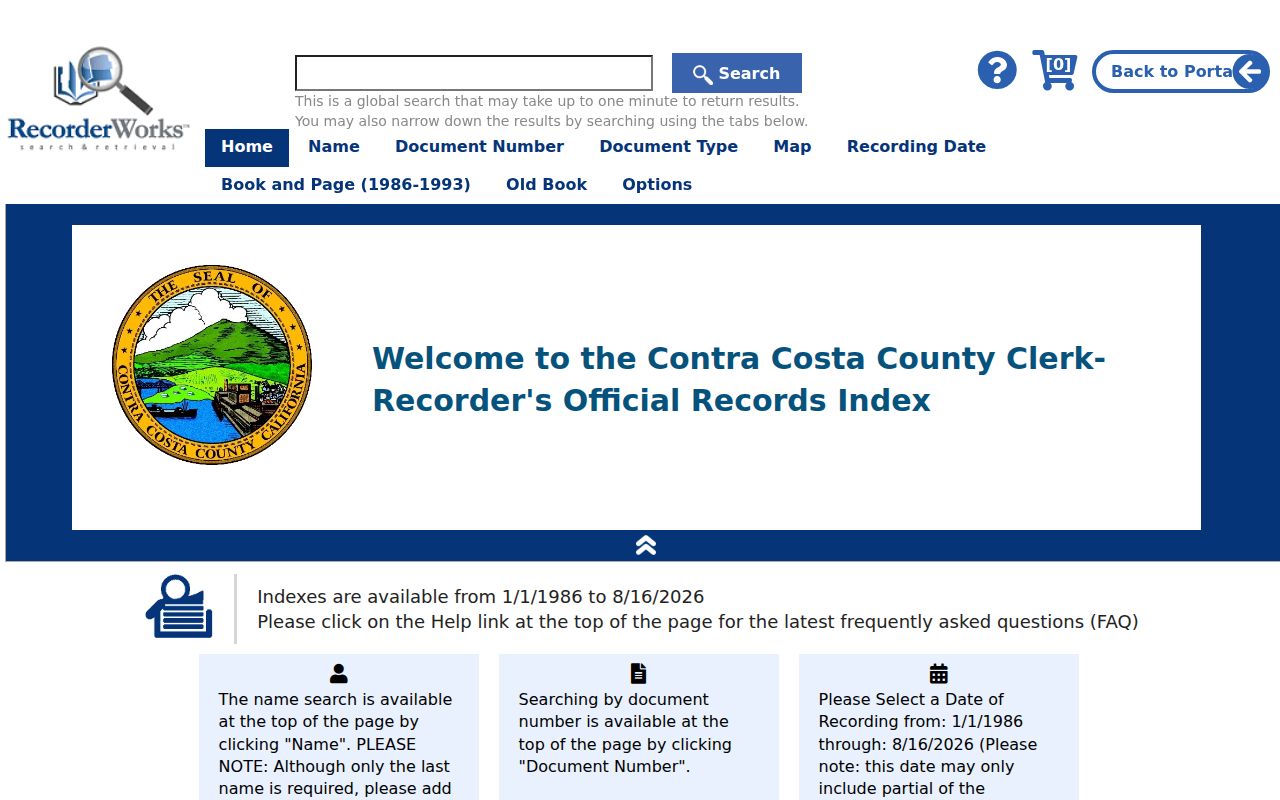
The indexed party and date fields can connect a present parcel to an earlier grantor, but the legal description remains the check against a same-name mistake.
Today's Lafayette Resident Directory Sources
A current Lafayette residents directory is really a set of partial rolls. Each row below answers a different question, and none should be expanded into a claim about every household. The assessor pair is strongest for parcel and ownership context, RecorderWorks is strongest for recorded parties, the voter system is limited to an authorized status or file route, and a public court docket is tied to a case rather than a neighborhood.
| Source | What it can show | Keeper | Access boundary |
|---|---|---|---|
| CCMAP / ParcelQuest | Address, APN, boundary, area, value, aerial and contours | County Assessor and GIS | Free web tools; owner names absent |
| Assessment roll | Owner, situs, mailing address, value and characteristics | Contra Costa Assessor | Counter or paid print outputs; protected entries withheld |
| RecorderWorks | Principal parties, document type, date and land record index clues | Clerk-Recorder | Free index; copies ordered separately |
| My Voter Status | An individual's registration status and election information | California Secretary of State | Identity-matched self-lookup, not street browse |
| Superior Court portal | Case parties, filing dates, hearings and register events | Contra Costa Superior Court | Public case and document rules vary by case type |
| Bizfile and FBN filings | Entity, agent, filing and business-address associations | State and County Clerk | Official affiliation, not proof of residence |
Property, deed, voter, court, and business sources can corroborate one another, but they do not have the same date or purpose. The best Lafayette residents directory result names the custodian and the exact field being relied upon.
| Official channel | Category compilation | How to read the difference |
|---|---|---|
| CCMAP and the assessment roll | A compiled search may combine parcel and address clues | Use the county map for geometry, then verify ownership fields with the Assessor. |
| RecorderWorks | A compiled search may merge names or lag a correction | Use document number, legal description, and recording date to test the result. |
| Superior Court and vital records | A compiled search may show an incomplete case or family link | Confirm the source-native case, certificate, eligibility, and access rule. |
Category search tools can help suggest a lead, but they do not replace the office that created or holds the official record.
Voter Status Is Not a Lafayette Street Roll
California My Voter Status is an identity-matched self-lookup. It can help a person confirm their own registration status, but it is not an open Lafayette residents directory and cannot be turned into a block-by-block browse. Full voter-file disclosure is limited by Elections Code section 2194 to listed purposes and eligible applicants. A statewide application asks for identity and contact information, the lawful-purpose choice and detail, security attestations, the requested file components, and a signature. Statewide processing is estimated at 7 to 14 business days, with a $100 statewide fee and separate county rules.
Approved file components can include voter name, date of birth, registration date, residence and mailing addresses, precinct, contact information, party preference, election history, and district data. Driver or state-ID numbers, the last four Social Security digits, unique identifiers, and signatures are excluded. Protected voters under Elections Code sections 2166 through 2166.8 and preregistered minors are also excluded. An absence is therefore not evidence that a person has no Lafayette connection.
The California My Voter Status portal is the appropriate starting point for an individual's own status question.
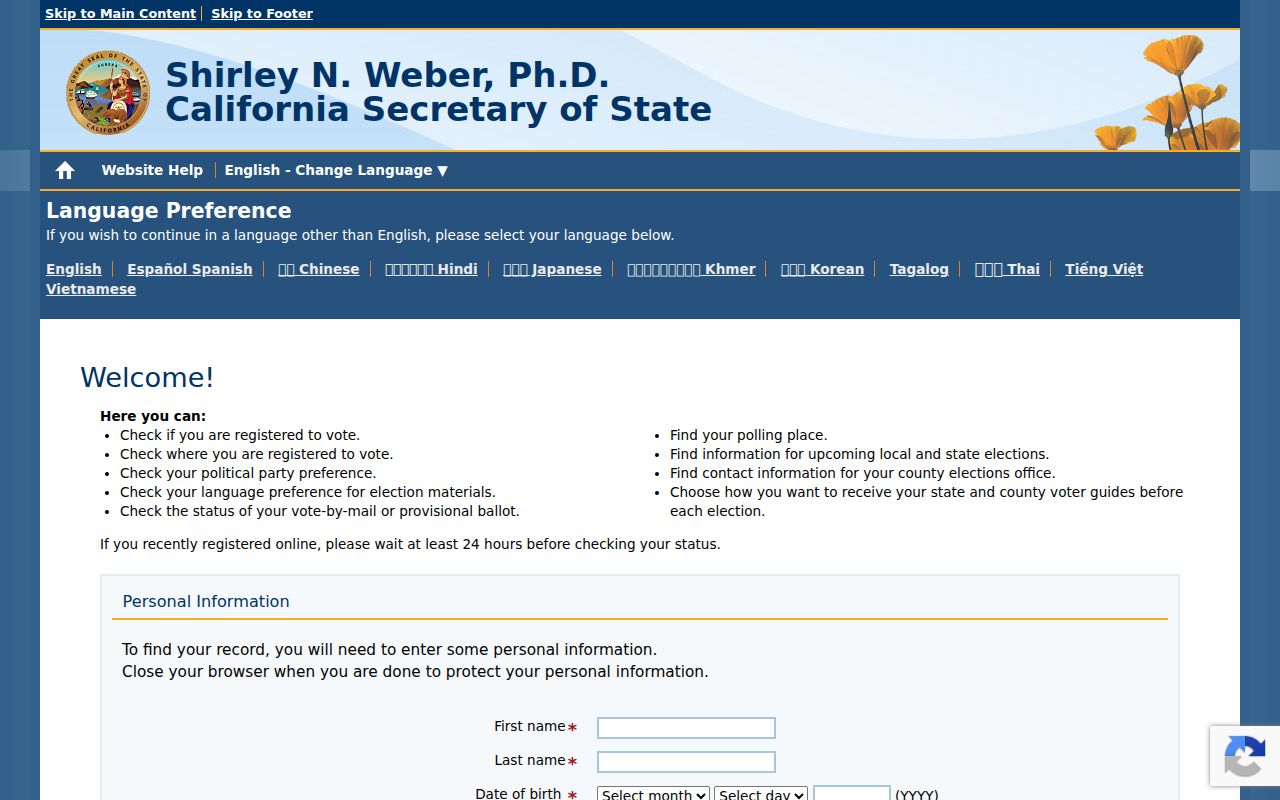
The screen reinforces the boundary between personal confirmation and a public resident roll.
Lafayette Planning and County Building Records
Address research splits at the local boundary. Lafayette Planning reviews land use, while Contra Costa County Building Inspection performs plan check, permit issuance, and inspections. Lafayette's Major Projects portal can expose an application number, scope, land-use classification, zoning, lot area, height or stories, floor area, status, plans or images, and project contacts. GeoCivix requires an account for submissions, and no public historical search was verified there. A city planning contact or permit applicant is connected to a project, not automatically to a household.
County Accela carries building permits from January 1, 1980 forward. Its Building tab offers General Search, Property Address, Permit Information or Permit Number, and Licensed Contractor Information routes. Status and history are free to inspect. Plans and supporting applications are not downloadable through the status search. County Records Research accepts requests for plans, permit documents, reports, calculations, and planning files, with an approximate ten-business-day response; stamped plans may need professional release and can add 30 days.
The Lafayette Major Projects search and the county permit path should be read together when an address has changed use or structure over time. A building record dates work. It does not establish who lived at the address.
Contra Costa Court Clues for Lafayette Names
Lafayette has no municipal court. Contra Costa Superior Court serves city cases, and the public portal provides case, hearing, and document access according to case type. Party-name and case-number searches can expose a caption, case category, filing dates, hearings, departments, and register events. Public civil, limited civil, and small-claims documents and minutes are generally downloadable when the record is public. Civil documents after November 13, 2007 are generally online; earlier physical files are off-site and take about ten business days to retrieve.
Probate registers of action may be online while documents and orders require the Court Records channel. Criminal minutes, documents, and orders are not downloadable in the same way. Family, juvenile, guardianship, conservatorship, adoption, sealed, and other sensitive case categories have tighter remote-access limits under California Rules of Court 2.500 through 2.507 and related access rules. The current counter is Wakefield Taylor Courthouse, 725 Court Street, Room 103, Martinez, weekdays 8 to 4, with phone service 8 to 3 at 925-608-1000. Federal matters use PACER, a separate case-search and fee system.
The Contra Costa Superior Court online services entry is a source for a case trail, not a substitute for identity confirmation.
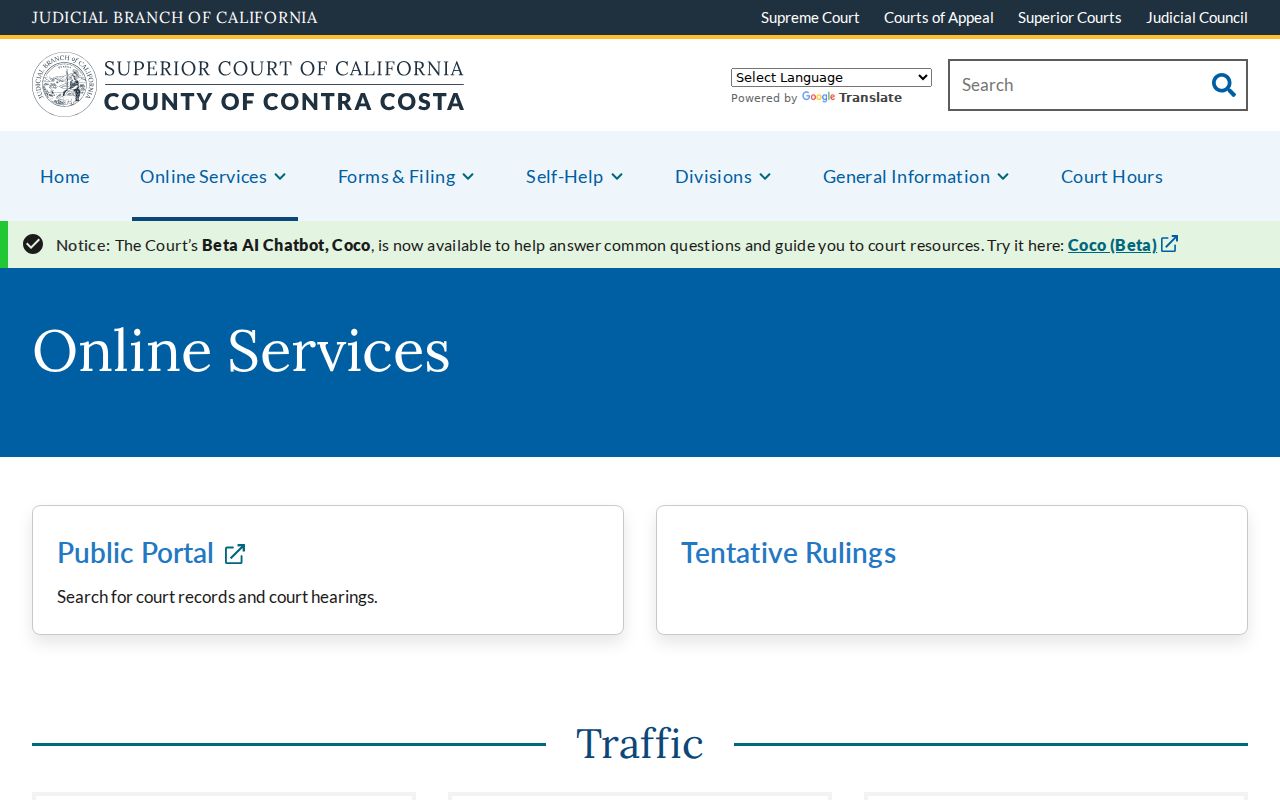
The county's current scanning project covers about 12 million noncriminal paper, microfilm, and microfiche pages, but it is not an instant complete online archive.
California Vital Records for Lafayette Events
Birth, death, public marriage, fetal death, stillbirth, and dissolution certificates follow California rules rather than a simple age cutoff. Contra Costa County and the California Department of Public Health handle different ordering paths. Health and Safety Code sections 103525 and 103526 distinguish authorized from informational copies. An informational copy may be available more broadly, carries a mark that it cannot establish identity, and is not the same product as an authorized copy. Confidential marriage records follow Family Code section 509, and adoption records remain sealed unless an authorized process applies.
The 2026 CDPH fees are $31 for birth, $26 for death, $19 for marriage, $18 for dissolution, $23 for fetal death, and $28 for stillbirth. A no-record search still retains its fee. The current California vital-record fee schedule is the check against older amounts. Mail orders use the CDPH Vital Records channel with the required payment, eligibility material, and any sworn or notarized statement. For older Lafayette family research, county registers, newspapers, church and cemetery material, and institutional indexes are historical clues rather than certified modern copies.
The California vital records office supplies the current statewide ordering rules and forms.
Lafayette's Historical Resident Directory Trail
The strongest verified digitized run is the Library of Congress U.S. Telephone Directory Collection. It contains countywide white and yellow pages with Lafayette listings, not a verified Lafayette-only Polk city directory shelf. Verified issues run from December 1934 through September 1941, September 1942 through March 1946, December 1946 through June 1948, March 1949 through September 1950, May 1951 through May 1952, and selected later issues through 1963. An August 1968 Contra Costa volume and Central Contra Costa issues from 1976, 1977, and 1978 add later snapshots, but the years should not be described as unbroken.
A telephone listing normally gives a subscriber surname, given name or initial, street address, and phone number. It does not promise a professional description, ownership, or a complete household. A missing entry can mean no phone, an unlisted number, another household member's name, or an OCR omission. Search surname variants and inspect the scanned page. Pair a known name from a deed, tax record, or census with the countywide book, then compare addresses and phone continuity across issues.
The historical collection shelf and oral-history route are developed in the Lafayette city directories collection reference. The local fallback is the Lafayette History Room inside the library complex, where staff can help with names, deeds, maps, memories, and oral histories.
The 1968 Contra Costa white pages scan shows why a countywide volume can still be valuable for a Lafayette name or address question.
The Lafayette History Room collection information gives the local starting point for names, deeds, maps, memories, and oral histories.
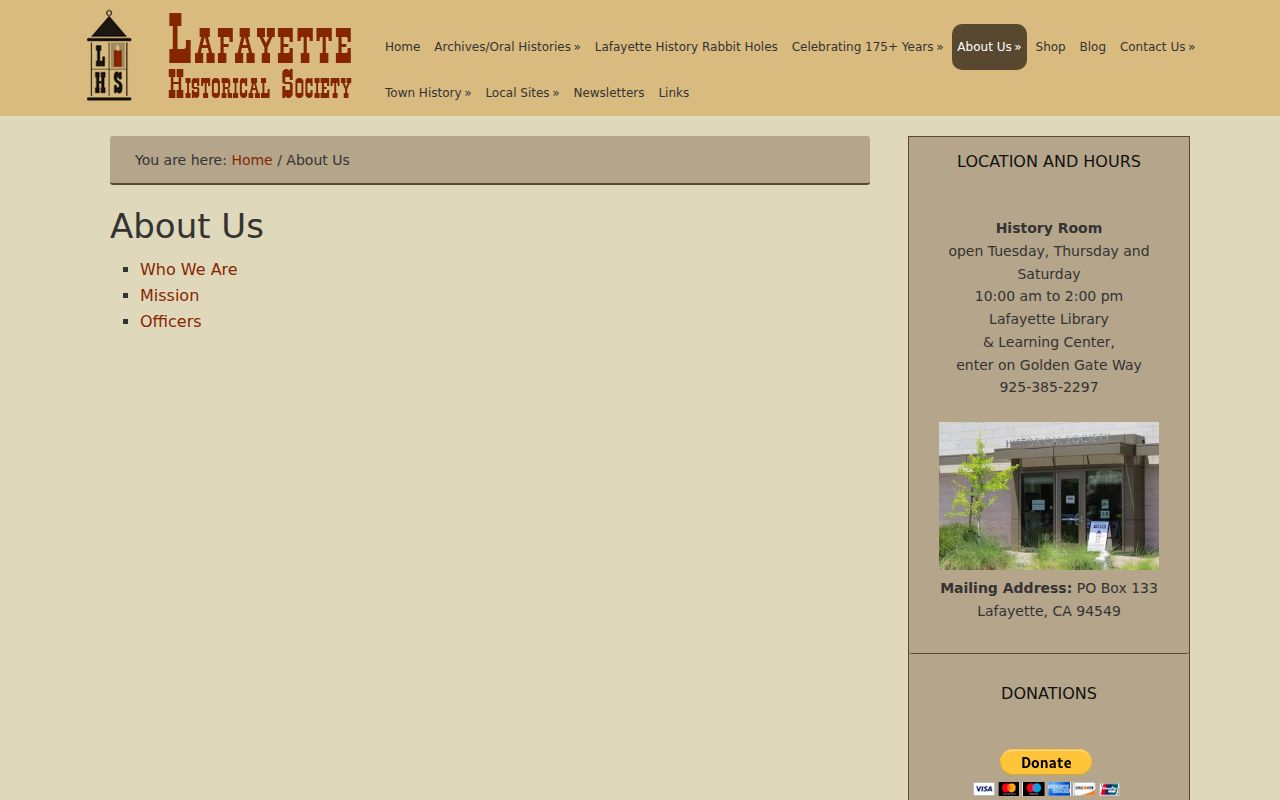
History Room material adds local context that a one-line telephone listing cannot provide, including place names, family connections, and remembered changes.
Lafayette White Pages and Census Pairing
Directory evidence becomes stronger when a telephone issue is paired with a public census year. The 1940 and 1950 population schedules can supply household members, ages, relationships, birthplace, and other schedule fields, while the telephone book fills some of the years between census snapshots. The 1950 schedule is currently the latest public population census under the 72-year rule. A stable phone number through an address change can help separate two people with the same surname, but a listing still describes a subscriber at publication time.
Pre-1968 Lafayette evidence is county-based because the city incorporated in 1968 after a 3,279 to 2,692 vote. County tax books from 1850 to 1910, court and probate material from the 1850s, newspapers from the 1860s, and maps reaching back to 1775 can fill parts of the earlier trail. The County History Center indexes more than 9,300 historic court files naming more than 61,000 people, along with naturalization, tax, map, obituary, and newspaper material.
The County History Center is therefore more than a general museum stop. Its physical indexes and staff research route can bridge a name that disappears from an online directory, while the Lafayette History Room supplies the municipal-era memory layer.
The County History Center collections provide a documented place to test older Lafayette names, parcels, court parties, and map references.
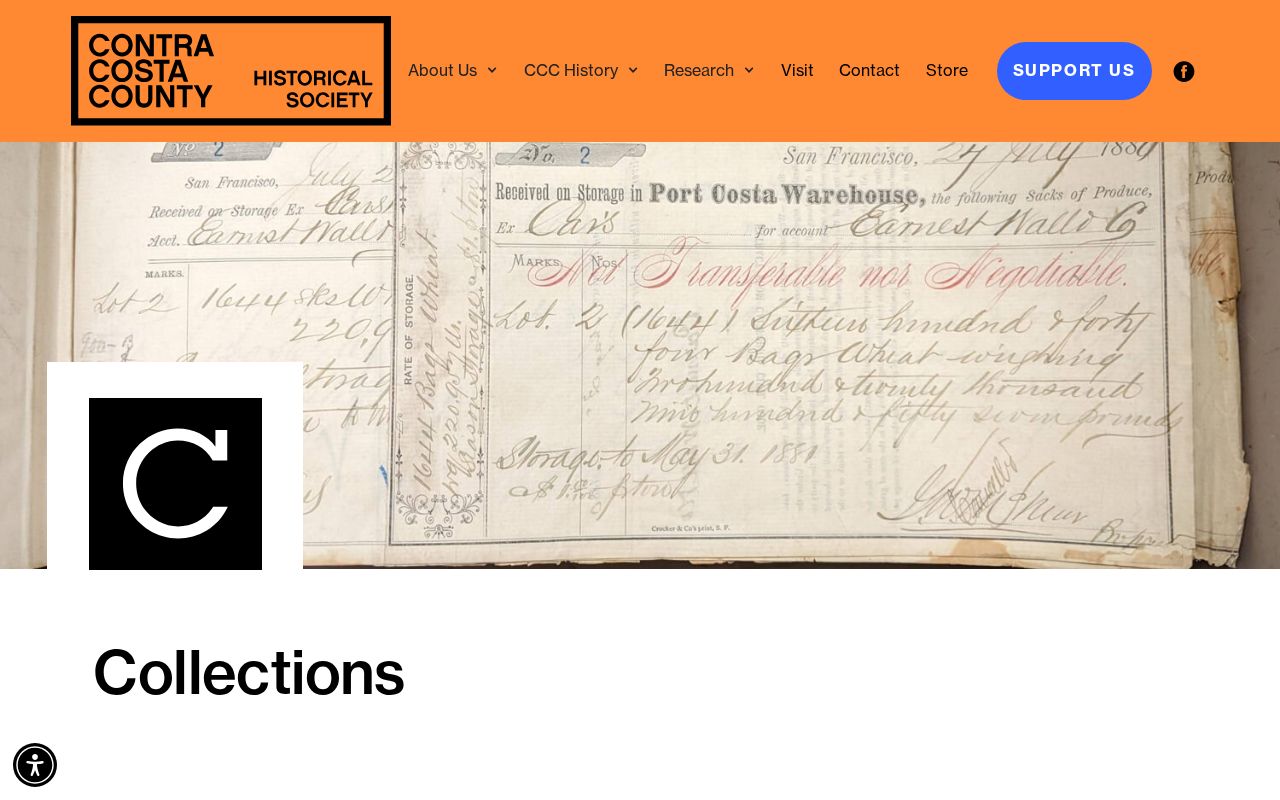
The scale of those holdings explains why an older Lafayette residents directory search may end at a staffed archive rather than a search box.
Why ZIP 94549 Exceeds Lafayette City Limits
Lafayette has one verified ZIP used for the local directory geography: 94549, with USPS destination LAFAYETTE CA 94549. The postal area extends beyond incorporated Lafayette into unincorporated surroundings. Greenhills and part of Saranap are identified as unincorporated areas inside the Lafayette sphere of influence. A sphere is a planning concept for possible future jurisdiction, not proof that an address is governed by the city.
The city-prepared boundary map places the incorporated city, sphere, school district, and ZIP on separate outlines. A postal Lafayette line therefore cannot establish city jurisdiction, a school boundary, a voter precinct, a parcel owner, or the agency that issued a permit. When the question is a land record, use the actual situs, APN, and legal description. When the question is mailing deliverability, use USPS address verification.
The Lafayette map hub helps keep postal and civic geography separate. This distinction is central to a Lafayette residents directory because records follow the custodian, not just the city name in a mailing line.
CPRA Requests for Lafayette Records
The California Public Records Act, Government Code sections 7920.000 and following, is the fallback when an identifiable city or county record is not available through a public portal. A request should describe the records sought and ask for inspection or electronic copies. The usual determination arrives within ten days, with a possible 14-day extension in qualifying situations. Inspection is free. Duplication and qualifying electronic extraction or programming costs may apply.
Exemptions can cover investigatory, personnel, draft, litigation, privileged, and legally confidential material. A custodian should release segregable portions when the rest can be withheld. CPRA cannot force an agency to create a residents directory, answer a research question, or override the separate rules for court files, voter files, and vital copies. For Lafayette municipal records, the City Clerk is the named contact; for building plans and related county material, County Records Research uses its own request path.
The California Attorney General's CPRA guidance explains the request framework, while local contact details determine which Lafayette custodian can respond.
Lafayette Privacy Tools and Lawful Searches
California's privacy rules offer routes for people who need less public exposure, but an opt-out does not erase a government deed, court index, tax record, or other record held by its custodian. Safe at Home can provide a designated mailing address for qualifying participants, and protected-voter rules withhold certain voters from public outputs. Recorded-document correction or redaction questions go to the recorder. A legitimate gap in a Lafayette residents directory can therefore reflect a lawful protection rather than a missing person.
California's DROP platform opened in 2026 as a category-wide request route for registered data brokers. A resident can create an encrypted profile and send one deletion or no-sale request to more than 500 registered brokers; compliance begins August 1, 2026. DROP does not delete Lafayette deeds, court records, or tax rolls from government custodians. It changes the commercial-data layer while official source records remain governed by their own rules.
The California DROP portal is the official place to start a broker deletion request. It should not be presented as a way to remove a parcel or court record from public custody.
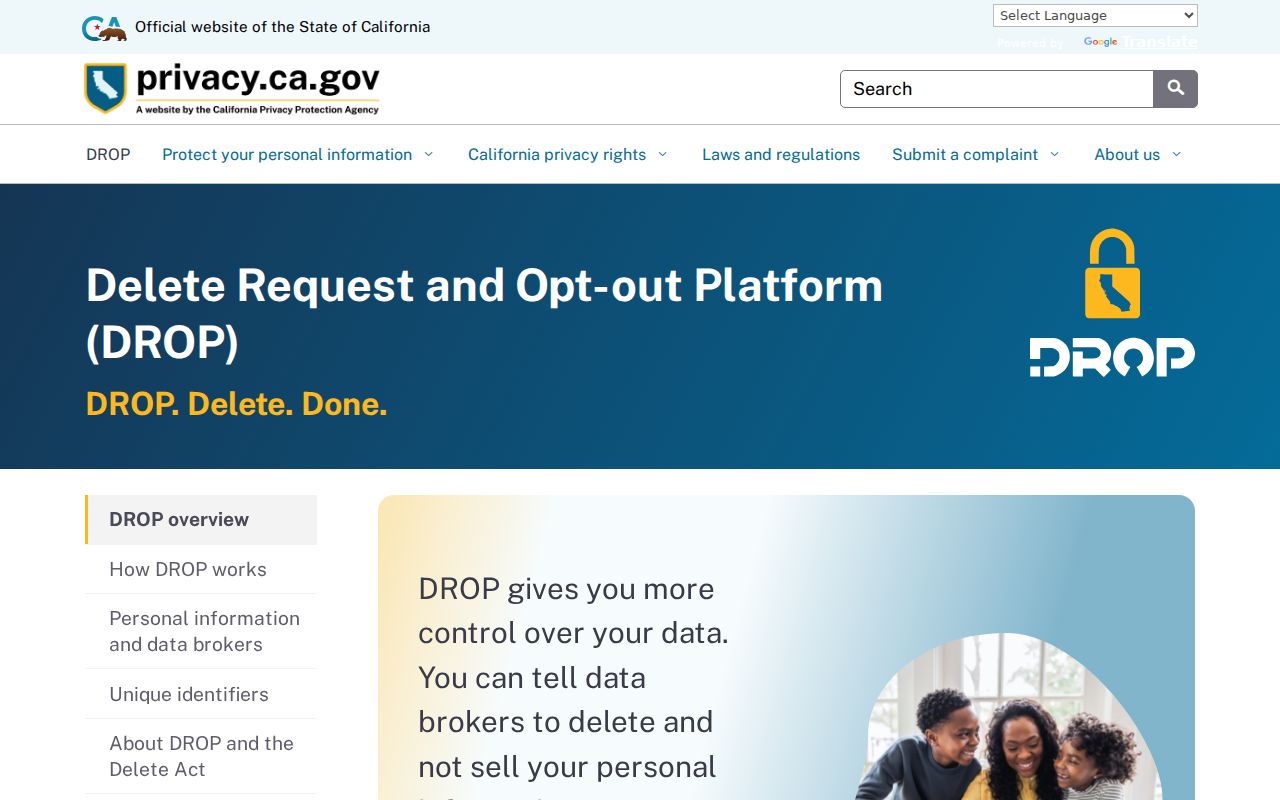
The privacy route belongs beside careful source labeling: owner, party, subscriber, voter, applicant, and resident are distinct terms.
Lawful personal use. Lafayette records are available for legitimate family-history, property, civic, and safety research within each custodian's rules. Do not use identifying information to stalk, harass, intimidate, or harm anyone.
Lafayette Resident Records Reach the Archives
Records geography changes with time. Lafayette's early evidence is county-held because the city did not incorporate until 1968. Later layers add city planning, county permits from 1980, modern parcel GIS, RecorderWorks from 1986, and digitized public court material. The county's FY 2024-25 archival transfer moved more than 5,000 official and vital books, 55,000 real-property maps, 30,000 microfilm rolls, and 500 boxes to a Records Archive Facility.
Contra Costa is also scanning about 12 million noncriminal court pages for a paperless system. The project excludes criminal and traffic material, and scanning should not be described as an immediate complete online archive. When an online search stops, the fallback may be a counter, a request form, a microfilm or map collection, the Lafayette History Room, the County History Center, a newspaper run, or the cemetery's original burial book.
A Lafayette residents directory is most reliable when its trail shows both the record and the gap. That approach keeps a modern parcel search, a countywide white page, a court docket, and an archival name index in their proper place without turning any single source into a complete list of residents.