
What a Lafayette Resident Lookup Can Confirm
A strong Lafayette name search begins by choosing a record that matches the question. The Contra Costa Assessor can connect a parcel to ownership, situs, and mailing fields, but owner names are hidden from the county web maps and mailing is not occupancy. The recorder names legal parties to property transactions. Courts show parties and events, while vital copies establish different kinds of family facts. Business filings, licenses, historical directories, newspapers, and probate add useful anchors without turning one result into a complete biography.
| Record | What It Confirms | Where to Search | Access |
|---|---|---|---|
| Assessor roll | Ownership, situs, and mailing fields | Assessor Maps & Property Information and counter | Owner hidden online; mailing is not occupancy |
| Recorder index | Named party and property transaction | RecorderWorks | 1986-present online; older material at the counter |
| Voter record | Lawful-purpose residency, status, and precinct | My Voter Status or an authorized file | Election Code §2194 limits use |
| Court docket | Name variants, parties, and case events | Contra Costa Court Public Portal | Access varies by case type; sealed matters withheld |
| Vital copies | Birth, death, marriage, or dissolution facts | County and California vital records | Informational versus authorized rules apply |
| Business and FBN (fictitious business name) filings | Affiliation, agent, and filing addresses | California bizfile and County Clerk-Recorder | Filings may show historical addresses |
| Professional license | Board, license, status, and public discipline | California DCA Search | Public fields vary by board |
| Probate and history | Decedent, estate, heirs, and name associations | Superior Court and County History Center | Registers and historical indexes differ from copies |
| Directories and newspapers | Name, address, phone, obituary, and context | Telephone scans, local papers, and history collections | Issue gaps, OCR errors, and unlisted households |
The first search depends on the starting clue. An address points toward an assessment parcel number (APN) and then a parcel owner at the Assessor counter. A legal name points toward RecorderWorks, the court party search, Bizfile, or DCA. A family question may need probate, a cemetery record, an obituary, or an authorized vital copy. Each source has a different keeper, date range, and proof value. A one-person search becomes reliable only when the second source shares a stable detail such as a middle initial, a legal description, a filing address, a spouse or relative, a phone number, or a precise case or parcel reference.
Note: A mailing address can point to a taxpayer or agent, but it never turns a property record into proof of occupancy.
Confirm the Right Lafayette Resident
Same-name records are the main hazard in a Lafayette identity check. Contra Costa County appears in many deeds, cases, licenses, and business filings, so a shared surname and city are weak evidence. Preserve the indexed spelling, initials, suffixes, married or maiden forms, and any place-name variant. A record-native identifier is stronger than a broad match: an APN and legal description for land, a case number for court, a document number for a deed, or an entity or license number for a filing.
- Property anchor
- Pair an owner name with the APN, situs, mailing field, and legal description. The online parcel view supplies the map path, while the Assessor counter supplies the protected owner field.
- Personal anchor
- A middle initial or name variant, stable phone, spouse or relative, or precise date can separate two people with the same name.
- Record anchor
- A case number, document number, entity number, license number, or consistent parcel links a result to the record rather than to a guess.
One-person verification works best when the search is stopped at every mismatch instead of being forced toward a desired answer.
- State the purpose and write every known name form before opening a portal.
- Find one independent anchor, such as a parcel, legal description, filing address, case date, or stable phone.
- Run the narrowest official index that fits the clue and save its native identifier.
- Check a second custodian for the same anchor, not merely the same county or surname.
- If the anchors conflict, keep both records separate and ask the custodian about correction or access.
This method distinguishes an owner from a party, a licensee from a resident, and a subscriber from every other person at an address. It also keeps a historical name association from being presented as a current fact.
Search a Lafayette Court Docket by Party
Contra Costa Superior Court serves Lafayette, and its Public Portal offers case and hearing routes for civil, limited civil, small claims, and probate matters, with a linked criminal search. The search controls matter. A broad party name can produce several captions, while a case number or court location narrows the result. Federal matters belong in PACER and are separate from the county system.
| Portal field or control | Type | Required | Use in a Lafayette name search |
|---|---|---|---|
| Court location | Conditional dropdown | Small-claims route | Select the location required by the instructions |
| Case number | Text | One search key | Best route when a citation is known |
| Party name | Text | Alternative key | Search the exact form, then test variants |
| Case category | Tab or mode | No | Civil, limited, small claims, or probate; criminal is linked separately |
| Hearings and calendars | Mode | No | Check scheduled events and departments |
| Search | Button | Action | Allow the portal pop-up if the result window is blocked |
When a public case is online, unlimited and limited civil or small-claims documents and minutes may be downloadable without a copy charge. Probate registers of action can appear online, while documents and orders require Court Records. Many public civil documents after November 13, 2007 are generally online. Earlier civil files are stored off-site and usually take about ten business days to retrieve. Confidential, sealed, juvenile, adoption, and other restricted case categories do not become public through a name search.
The Contra Costa civil online case information page shows the county's public search route and the case-type limits that shape a careful lookup.
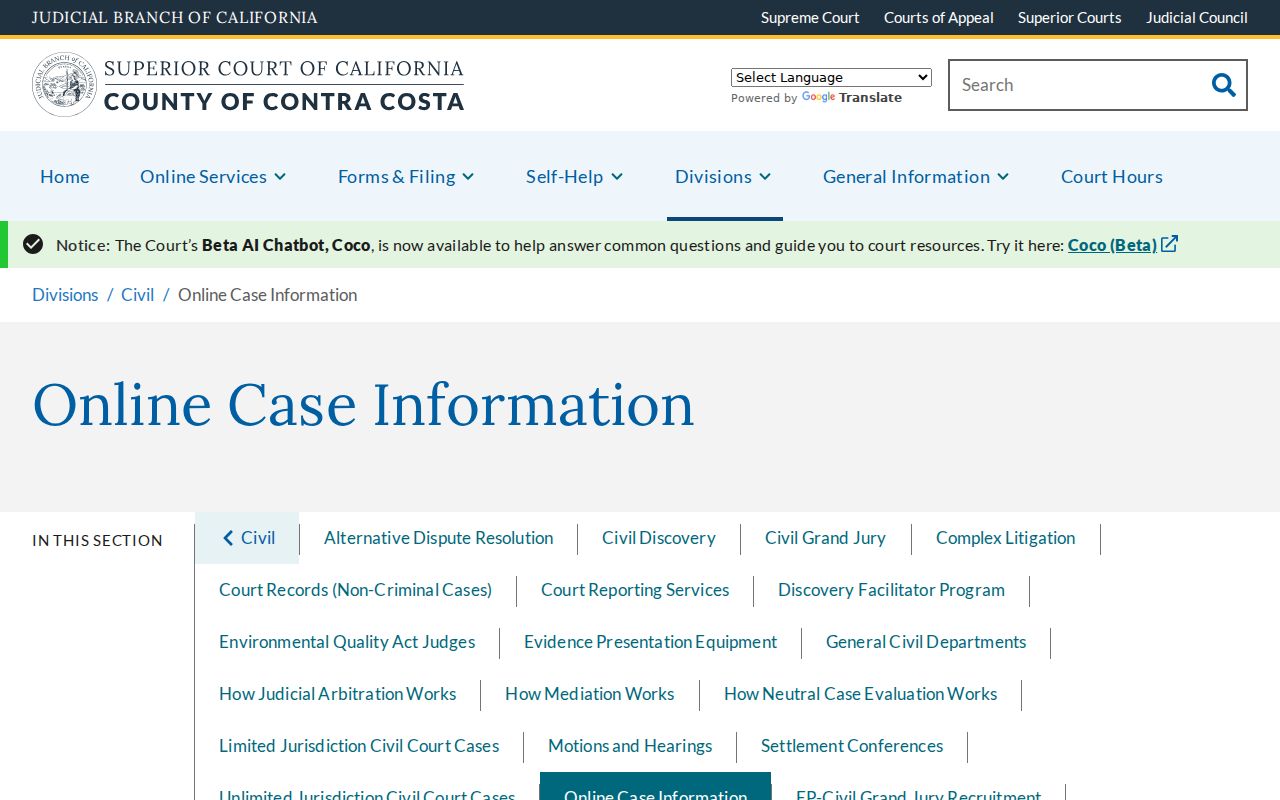
The civil portal is a starting index, not a promise that every named person is a Lafayette resident. Use the caption, party role, filing date, department, and address clue together before treating a case as an identity anchor.
In-person access remains important. Wakefield Taylor Courthouse, 725 Court Street Room 103 in Martinez, handles Court Records on weekdays from 8 a.m. to 4 p.m.; phone service is 8 a.m. to 3 p.m. at 925-608-1000, and picture ID is required at the counter. REC-01 mail or drop-box requests ask for the case number or name, Civil, Family, or Probate selection, requester name, phone, agency, and documents requested. A qualifying search is $15, copies are 50 cents per page, certification adds $40 per document, a certified dissolution judgment is $15 including copies, and exemplification is $50 plus copies. A confidential-case requester must be a party and send a notarized identification copy.
Read a Lafayette Court Result Before Ordering
A court result can answer who appeared in a case without proving where that person lived. Read the record in layers. The docket supplies the index trail, a public document supplies the underlying text or image when available, and a certified copy is a formal copy from the custodian. Criminal minutes, documents, and orders are not downloadable through the public route, and Rule 2.503 limits remote access in family, juvenile, guardianship, mental-health, harassment, elder-abuse, and other sensitive matters.
- Case number: the stable identifier for follow-up requests.
- Caption and parties: the case name and each party's role.
- Category: civil, limited, small claims, probate, or the linked criminal route.
- Filing dates: the time sequence for comparing a person with other records.
- Hearings and departments: scheduled events and the court unit handling them.
- Register events: filings, orders, dispositions, or other docket activity.
The Contra Costa criminal court-records page illustrates a separate records channel for minutes, documents, orders, copies, and restricted material.
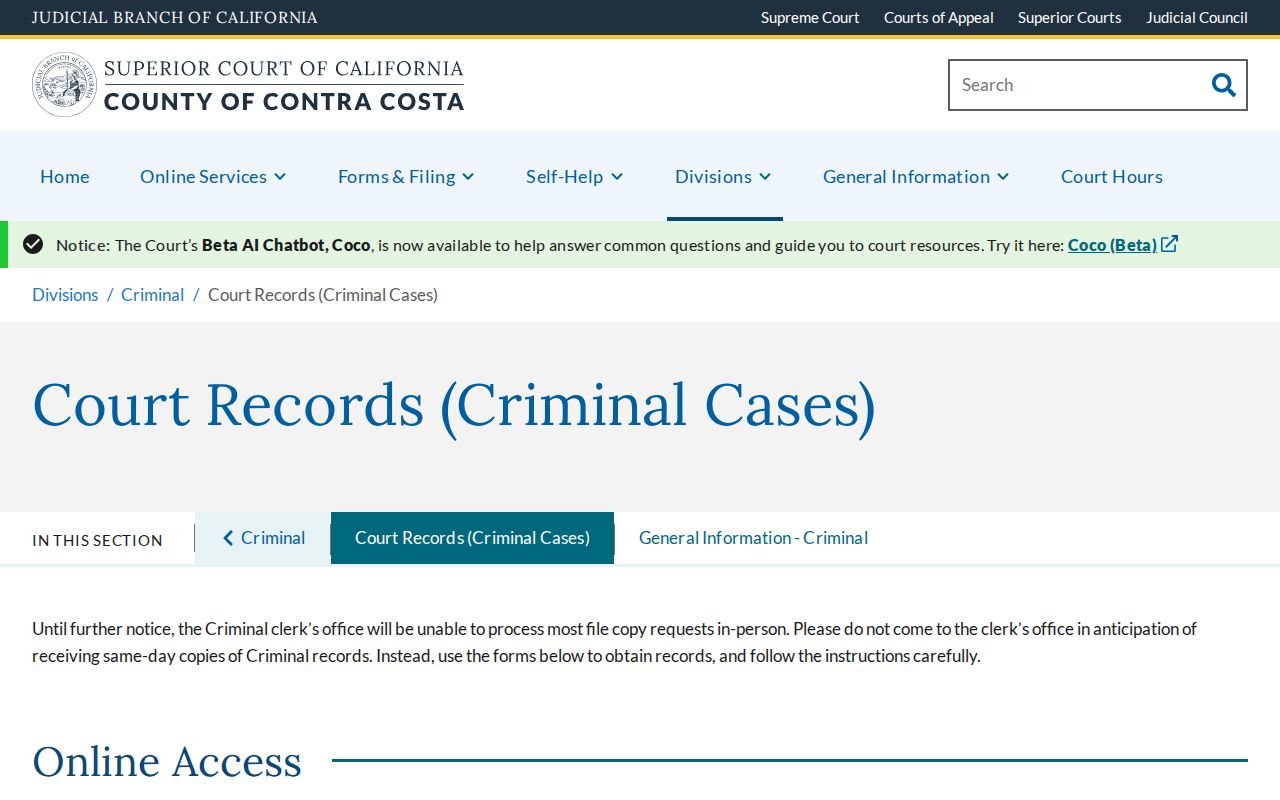
That distinction matters in a person search: a visible index event can be real while the document image remains unavailable, confidential, or accessible only through the Court Records counter.
- Docket
- A running case index that lists identifiers, parties, dates, hearings, departments, and register events.
- Index versus image
- An index is the searchable label and summary. An image is the scanned or filed document behind that label, when public access allows it.
- Certified copy
- A copy issued with the custodian's certification. It is different from viewing a free index or downloading an uncertified public image.
- Register of actions
- The court's chronological case activity record, which can be online even when the related order or document must be requested.
Order Lafayette Vital Copies Correctly
California vital records use an authorized-versus-informational system rather than a simple age cutoff. Health and Safety Code §§103525-103526 govern birth, death, and public-marriage copy access. Confidential marriage copies follow Family Code §509, and adoption records stay sealed unless an authorized process opens them. An informational copy can provide facts for research, but it is marked and cannot establish identity in the way an authorized certified copy can.
| Record | Custodian | Public or copy rule | 2026 fee |
|---|---|---|---|
| Birth | Contra Costa Recorder or California Department of Public Health (CDPH) | Informational access is broader; authorized copies require eligibility and may require a sworn notarized mail statement | $31 |
| Death | County or CDPH | Informational copies are generally available; authorized eligibility still applies | $26 |
| Public marriage | County event recorder or CDPH | Informational and authorized rules differ | $19 |
| Confidential marriage | Issuing county clerk | Parties or a court-order requester under Family Code §509 | State schedule lists $19 |
| Dissolution certificate | CDPH; decree at Superior Court | The certificate and court judgment are different records | $18 certificate |
The VS 111 birth application shows what the custodian needs before a copy is released. Birth and parent details identify the event, while the applicant's relationship, contact information, agency or case details, quantity, payment, and any required notarized statement control the request. The form also separates an authorized certificate from an informational one and asks about sealed records.
- Certificate type: choose authorized or informational.
- Relationship: identify the qualifying relationship or legal authority for an authorized copy.
- Birth data: provide names, city or county, and exact or approximate date.
- Parents: enter names at birth or use the form's none choices.
- Applicant and agency: provide mailing address, phone, email, reason, and any case or contract information.
- Quantity and payment: request the needed copies and include the required payment or notarized materials.
County Clerk-Recorder service in Martinez and CDPH mail ordering are the modern channels. For older Lafayette questions, cemetery books, newspaper obituaries, church material, and historical indexes can establish a lead without pretending to be a current certified copy. CDPH also lists fetal-death and stillbirth certificates, and a no-record search retains its fee.
Note: An informational copy can support family research, but it is marked and cannot serve as an identity document.
Trace Business and License Clues for a Lafayette Name Search
California bizfile Online holds more than 17 million documents. A basic search accepts an entity name or file number, and a corporation number is searched without its leading C. Advanced filters add entity type or group, status, and initial-filing date. Results cap at 500. Summary fields can include entity name and number, formation date, status, standing, jurisdiction, street and mailing addresses, agent, statement due date, and links to free filing PDFs.
The California bizfile business search shows the name and file-number route used to locate entity records and filing PDFs.
A filing address or agent relationship is an official business connection, not proof of a home address. The online summary is not a complete or certified record. Limited-liability partnerships and general partnerships are excluded from the ordinary entity search and require the Business Entity Records Order Form.
For a licensed person or business, the California Department of Consumer Affairs (DCA) Search can filter by board, license type, number, business, first or last name, city, county, status, discipline, and documents when the board supplies those fields. A license result can confirm a public credential, status, or discipline record. It should not be stretched into residence evidence. Certified Secretary of State copies, County FBN documents, and board records are the mail or counter fallbacks when a legal-quality copy is needed.
The California DCA professional-license search provides the umbrella route for board, license, business, status, and discipline results.
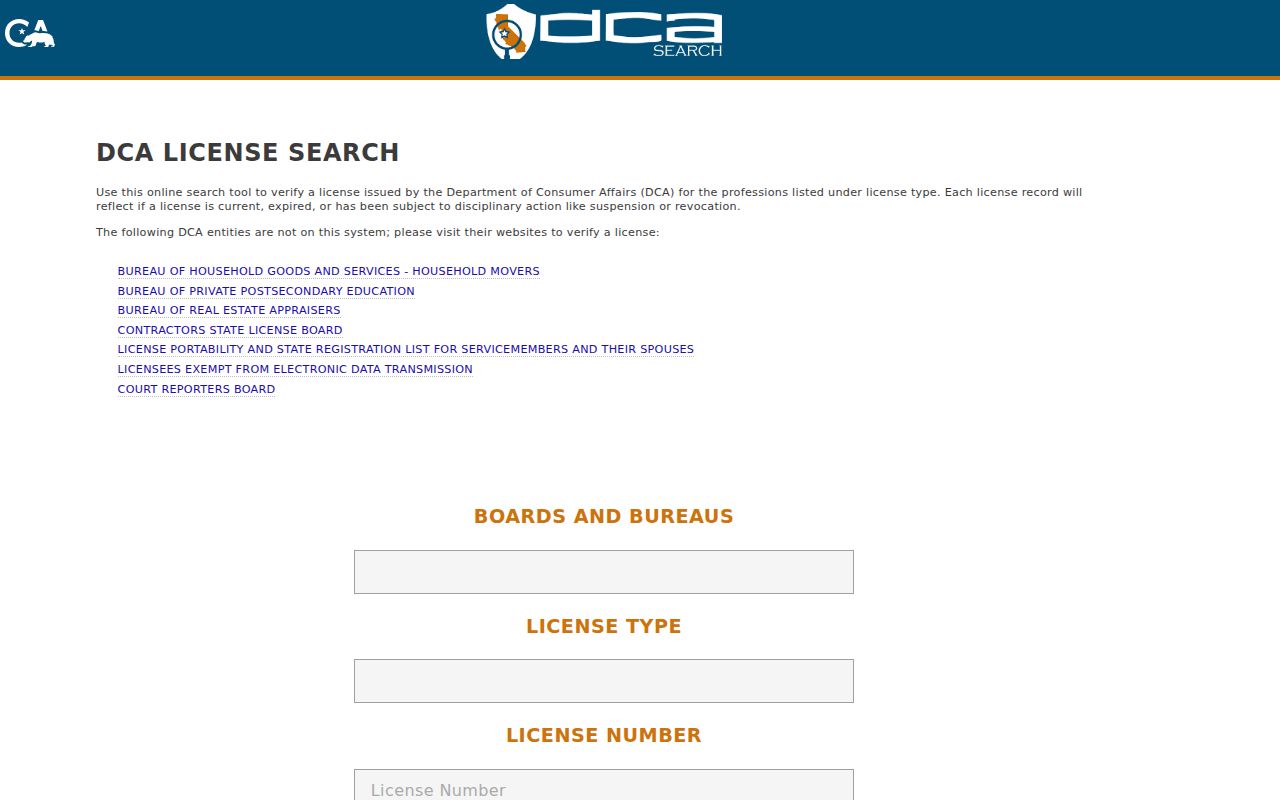
Read the entity number, license number, filing date, and business address as separate anchors. A repeated address across an entity filing and a license result is stronger than a name alone, but it still describes an official filing connection.
Human Leads Beyond a Lafayette Name Search
Some Lafayette name-search questions are really family-history or reconnection questions. Probate can identify a decedent, petitioner, heirs, and property. A directory disappearance can lead to the Lafayette Cemetery register, a local obituary, then a probate index. A former classmate may surface through a yearbook, newspaper, oral history, or a telephone issue. A birth-parent search must use California court or adoption procedures because modern adoption records are not an open name index.
- Heir research: pair a probate register or file with an obituary, deed succession, and cemetery or death record.
- Birth-parent research: use authorized California adoption and court mechanisms, never a guessed public birth index.
- Former classmate research: compare yearbooks, local newspaper holdings, oral histories, and telephone issues.
- Historical name research: follow a surname through the Lafayette History Room's category and name indexes before assuming a current connection.
The Lafayette History Room, inside Lafayette Library & Learning Center, is open Tuesday, Thursday, and Saturday from 10 a.m. to 2 p.m. at 925-385-2297. Its local photos, deeds, maps, memories, and oral histories supply context that a one-line index cannot. Oral-history name and category material can reconnect a person with a school, family, business, or civic setting.
The Contra Costa County History Center collections add court, probate, naturalization, tax, map, obituary, cemetery, and directory material. The center reports more than 9,300 indexed historic cases naming more than 61,000 people, plus historical tax books, maps, and naturalization files. Staff research requests are accepted, and fragile maps or physical files may require an appointment or a quoted copying charge.
Note: Historical directories and oral histories show a person in a time and setting, not a guaranteed current residence.
Why Voter Status Is Not a Lafayette Name Search
California My Voter Status is an identity-matched self lookup. It is not a names-by-address tool and cannot be repurposed into a Lafayette block or street directory. A voter-file request under Elections Code §2194 is limited to candidates, qualifying committees, election, scholarly, journalistic, political, or governmental uses. The state voter-file request instructions require requester identity, organization, lawful-purpose choice and detailed use, security attestations, components requested, and a signature. Statewide files cost $100; a specific-voter request is $30 each up to $100 for ten, with county files following county fees. Processing is estimated at 7 to 14 business days.
Authorized voter files can contain name, date of birth, registration date, residence and mailing address, precinct, contact information, and party preference. An optional history file shows election, date, and method, never ballot selections. District files show precinct and district number or type. Driver or state-ID numbers, the last four Social Security digits, unique identifiers, and signatures are excluded. Protected voters under Elections Code §§2166-2166.8 and preregistered minors are excluded as well. Unauthorized use is penalized under Elections Code §18109(b).
Voter boundary. A lawful file request may answer an approved election or research question, but the public status portal is not an open Lafayette resident directory.
When a Lafayette Name Search Needs a Custodian
When an online search ends at a missing name, a redacted field, or an older date, go to the office that created the record. The California Public Records Act, Government Code §§7920.000 and following, supports identifiable agency-record requests. An agency ordinarily makes a determination within ten days and may extend by fourteen days. Inspection is free, while direct copies or qualifying electronic extraction can cost money. Exempt material may be withheld or redacted, but segregable portions can still be released. A request asks for records, not for an agency to create a people directory.
For Lafayette municipal records, written requests go to the City Clerk at 3675 Mount Diablo Boulevard, Suite 210, Lafayette, California 94549, 925-284-1968, cityhall@lovelafayette.org. Planning evidence may sit with the City, while County Building Inspection handled plan check, permit issuance, and inspections. For county land records, the Clerk-Recorder counter at 555 Escobar Street in Martinez bridges the RecorderWorks 1986 cutoff. For a court file, use the Wakefield Taylor Courthouse counter, phone desk, or REC-01 mail and drop-box route described above.
A state fallback can be more fitting than a local name search. The CDCR Inmate Locator and BOP cover separate custody systems; California's official public registry has its own disclaimer and posting rules; Unclaimed Property is a free name search that does not prove current residence. A business, license, court, or vital-record correction belongs with its custodian. A commercial compilation cannot amend a deed, docket, voter file, or certificate.
- Write the exact record type, date range, name form, and native identifier.
- Ask the custodian for inspection, an electronic copy, or the correct certified-copy route.
- Keep a redaction, sealed-file, or no-record response separate from a claim that the person never existed.
- Compare a second independent record only after the first office confirms the record's scope.
Privacy Boundaries for a Lafayette Resident Lookup
California privacy rules create real gaps. Safe at Home can substitute a designated mailing address for qualifying participants, and protected-voter provisions can withhold an address. DMV address data is restricted. Government-record data is excluded from some consumer-privacy rights, so a deletion request cannot erase a deed or court index kept by its custodian. California's DROP system launched in January 2026 for one encrypted deletion or no-sale request to more than 500 registered data brokers; broker compliance begins August 1, 2026. DROP does not delete government records.
The California DROP privacy portal is a data-broker request route, not a government-record correction tool. For qualifying safety situations, the Safe at Home program explains why a legitimate address may be absent or substituted across public outputs. Do not reverse a substitute address by comparing databases.
Lawful use. A Lafayette name search is for personal, lawful research, family history, reconnection, and civic understanding. Do not use a record to stalk, harass, intimidate, or cause unwanted contact; California law can impose criminal or civil consequences.
When a result is wrong, correct the source record at the custodian rather than trying to repair a compilation. Keep the labels precise: owner, party, applicant, subscriber, voter, licensee, or historical name association. That discipline is the final safeguard in any Lafayette person search.